BARIUM and COMPOUNDS Toxicology
Compounds
The main water soluble salts are: the acetate, chloride, hydroxide, oxide, nitrate.
The main insoluble salts are : the arsenate, carbonate, chromate, fluoride, oxalate, sulphate.
Uses
- Rodenticide, insecticide, fungicide
- Manufacture of glass
- Manufacture of ceramics
- Vulcanization of synthetic rubber
- Production of pigments
- Manufacture of electronic components
- Manufacture of detergents for lubricating oils
- Purification of industrial waters
- Industry of painting
- Industry of paper
- In pottery
- Coating of welding electrodes
- Surface treatment in the metallurgical industry
- Barium sulphide is used in the production of certain types of fluorescent tubes
- Barium sulphate is used in medical radiology and in the manufacture of white pigments (litophone)
- Etc.
Exposure
-
Environmental
Barium naturally occurs at low concentrations in ambient air, usually < 0.05 µg/m3, but is found at relatively high concentrations in soils , nearly 500 mg/kg. In fresh surface water, concentrations may vary from < 5 to 15,000 µg/L. and it contributes to water hardness. Foodstuffs also source barium and the daily human intake has been estimated to be in the order of 1 mg.
-
Industrial
The pulmonary route of entry is the most significant in the industrial setting (see exposure limit recommendations).
Routes of entry
Soluble barium salts are well absorbed by pulmonary and oral routes of entry. Insoluble salts inhaled and deposited are eliminated only slowly and can accumulate in the lungs as a result of long-term exposure. Barium compounds are not reputed to penetrate the skin unless the cutaneous barrier is broken (as in chemical burns; a case has been described in the relevant medical literature which had been caused by barium chloride in fusion).
Toxicity
-
Solubility
The toxicity of barium salts is related largely to their solubility, which conditions their digestive absorption and bioavailability. Water and acid soluble salts are very toxic when ingested.
The carbonate BaCO3 is insoluble in water at neutral pH, it becomes soluble in acid environments, which is not without consequence in vivo because of the gastric pH. There would be under this condition, production of barium chloride BaCl2 from the solubilized carbonate (one the most toxic of soluble barium salts).
-
Metabolism
The biological half-life of barium varies between 2 and 20 hours. Absorbed barium is mainly deposited in bones, which accounts for 93% of the body burden in man. It is mainly excreted in feces and a small part (1 to 10%) in urine.
-
Exprimental toxicity
In the case of barium carbonate, the Lethal Dose Fifty (LD50) is :
- mouse (ingestion): 200 mg/kg,
- rat (ingestion): 418 mg/kg,
This makes it a very toxic chemical by ingestion.
Barium stimulates the striated and cardiac muscles. This hyperstimulation causes arrhythmias, myoclonus, digestive disorders and arterial hypertension by direct effect on the smooth muscles of the arterial wall independently of the renin-angiotensin system and catecolamines.
-
Acute intoxication by ingestion
The lethal dose in man varies, according to barium compounds involved, between 1 and 15 g. by ingestion. Acute intoxications are rare and generally due to suicidal attempts with the chloride or the carbonate.
Some cases of collective food intoxications were reported, related to food contamination, and to confusion between carbonate and barium sulphate at the time of radiological examinations. Barium carbonate having been substituted accidentally for potato flour during the preparation of sausages, 144 people were poisoned in Israel in 1963. Two patients died.
-
Clinical findings
At the beginning, there are digestive disorders :
- diarrhoea, sometimes hemorrhagic,
- severe abdominal pain,
- nausea and vomiting.
Initially there is intense asthenia, sometimes accompanied by:
- muscle cramps,
- myoclonus,
- muscular contractures.
Later there is :
-
gradually increasing flaccid paralysis involving the 4 limbs, the diaphragm, and the pharyngolaryngeal junction, which often requires to resort to artificial ventilation.
-
the clinical picture may mimick a rapidly evolving Guillain-Barré's syndrome
- respiratory disorders and rhabdomyolysis were reported.
Cardiac symptoms and clinical signs dominate the prognosis :
- Initially there can be arterial hypertension sometimes followed by hypotension due to digestive liquid losses (diarrhoea, vomiting).
- Disorders of excitability and conduction,
- Ventricular tachycardia,
- Torsades de pointes (" twisting of the points ") leading sometimes to an unexpected ventricular fibrillation responsible for the fatal types of the intoxication.
Renal complications were reported in an exceptional cases:
- Acute kidney failure with preserved diuresis,
- Opacification of kidneys due to barium precipitation.
Death occurs by respiratory failure or ventricular fibrillation.
-
Laboratory findings
- Biological examinations highlight disorders related to water loss caused by diarrhoea.
-
Hypokaliemia (low levels of blood potassium) sometimes very significant with acidosis, is characteristic of the intoxication. However, initially it can be masked by respiratory acidosis.
- Electrocardiographic changes reflect cardiac effects
-
When the blood concentration of barium was measured in the course of acute intoxications, values greater than 100 µg/L were observed. However, blood concentrations fall quickly during the first 48 hours to become again lower than 10µg/L.
- As renal clearance of barium is rapid, the duration of the intoxication lasts 2 to 4 days.
-
Treatment
It comprises usual symptomatic measures :
- Gastric lavage, rehydration and correction of hydroelectrolytic imbalance.
-
Oral magnesium sulphate (Epsom salt) or sodium sulphate makes it possible to precipitate soluble barium salts present in the digestive tract as barium sulphate (insoluble). Perfusion of the same salts by intravenous route could cause renal complications, by intratubular precipitation of barium.
-
Perfusion of important amounts of potassium is often necessary to correct hypokaliemia mainly due to disorders of potassium membrane transfer, which are corrected only by the elimination of circulating barium.
- Treatment of cardiac disorders is symptomatic.
-
-
Pulmonary effects
Handling of pulverulent barium sulphate was accompanied, at the time of already old observations, by benign pneumonias generally resulting in pulmonary radiological images consisting of nodules disseminated in both lung fields without clinical symptoms, nor anomalies of respiratory functional tests, it is barytosis. It also occurs during significant exposures to lithophone and barium oxide.
On the other hand, serious fibrosis was reported among workers of barium mines because of the presence of crystaline silica in the ore.
Aqueous solutions of barium hydroxide and oxide are strongly alkaline and can cause significant ocular burns and skin irritation.
-
Local effects
The carbonate and the sulphate of barium are irritating to the mucous membranes of the upper airways, the carbonate can also be irritating to the skin and the eyes.
Carcinogenesis
Barium chromate(VI) is the only compound recognized as carcinogenic in man.
Mutagenesis
Barium chloride dihydrate was not mutagenic in Salmonella typhimurium, nor did it induce sister chromatid exchanges or chromosomal aberrations in cultured Chinese hamster ovary cells.
Developmental effects
In a mating trial, no adverse anatomical effects were observed in the offspring of rats or mice receiving up to 4000 ppm barium chloride dihydrate in the drinking water, although rat pup weight was reduced.
Reproduction
In rats and mice receiving up to 4000 ppm barium chloride dihydrate in the drinking water, reproductive indices were unaffected.
Exposure limit recommendations
The TLV-TWA (ACGIH) for soluble barium salts is 0.5 mg/m3. The TLV for barium sulphate dust (insoluble) is 10 mg/m3.
Prevention
Good housekeeping of your studio is important (as for any other chemical).
Avoidance of processes generating unnecessary dust is also important.
Depending on the severity of exposure, local ventilation should be used and the aspired air should be vented outside to avoid producing dust from work tables and the floor.
Very effective filter masks should be worn (if the severity of exposure justifies it during preparation of glazes and clays).
It should be forbidden to drink, eat or smoke in the workshop.
Especially, one should not confuse barium carbonate with table sugar when preparing coffee.
Medical surveillance
An electrocardiogram is recommended as part of the periodical examination of workers exposed to soluble salts. Periodical urinary and blood mesurements could also be carried out; in subjects not professionally exposed blood concentrations are lower than 10 µg/L, and lower than 20µg/L in the urine.
References
- Chemical Hazards of the Workplace, Proctor & Hughes, last edition.
- Clinical Environmental Health and Toxic Exposures, Sullivan & Krieger, last edition.
- Encyclopédie Médico-Chirurgicale, Toxicologie-Pathologie Professionnelle, Pr. S. Dally, Paris, Juillet 2001.
- Occupational & Environmental Medicine, Ladou J., last edition.
- Occupational Medicine, Zenz C., last edition.
- Répertoire Toxicologique de la Commission de la Santé et Sécurité du Travail du Québec.
- Sax's Dangerous Properties of Industrial Materials, Lewis C., last edition.
- Toxicologie Industrielle et Intoxications Professionnelles, Lauwerys R. last edition.
By Edouard Bastarache
Related Information
My head was in the clouds and I appreciate the grounding!
This picture has its own page with more detail, click here to see it.
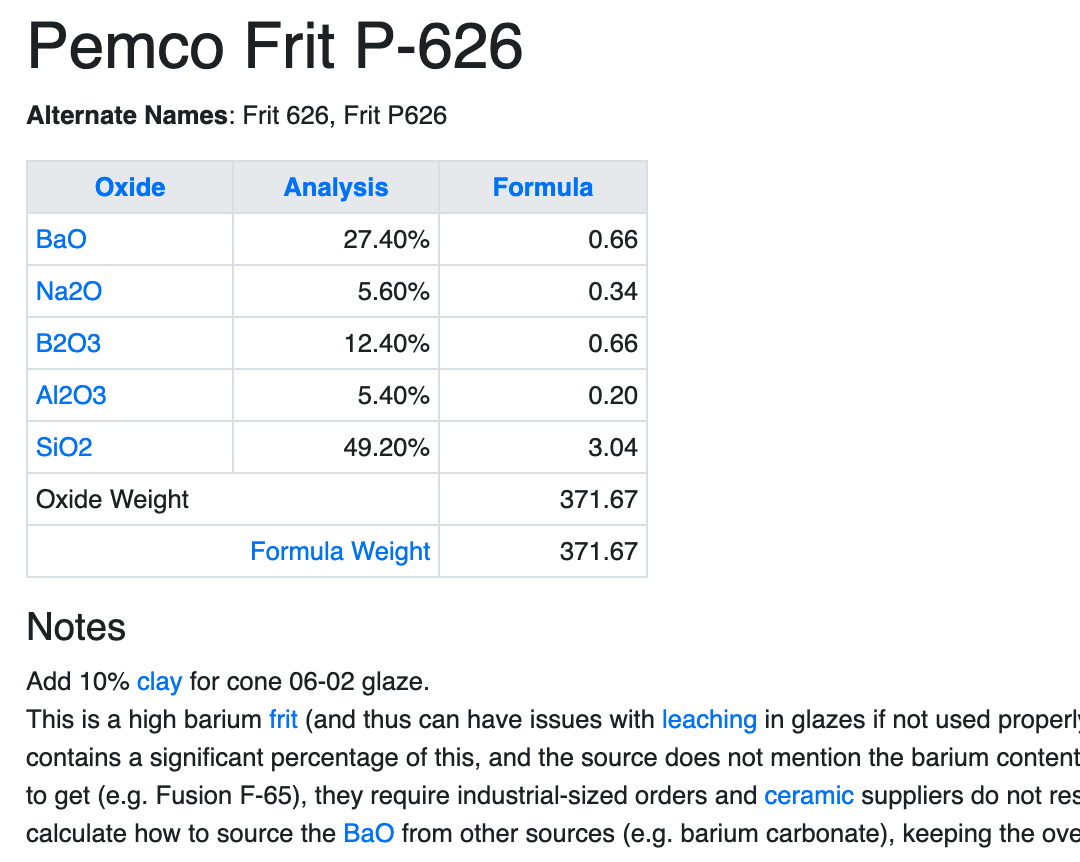
She was searching for a a matte, mottled white, rustic. For functional surfaces. And it contained this frit. The source from which she got it did not mention the barium content. Barium is certainly not a requirement to achieve a matte surface at cone 6, there of lots of ways to do it. And there are multiple matte mechanisms that can be exploited.
Links
| Typecodes |
Article by Edouard Bastarache
Edouard Bastarache is a well known doctor that has written many articles on the subject of toxicity of ceramic materials and books on technical aspects of ceramics. He writes in both English and French. |
| Materials |
Barium Sulfate
|
| Materials |
Barium Carbonate
A pure source of BaO for ceramic glazes. This is 77% BaO and has an LOI of 23% (lost at CO2 on firing). |
| Materials |
Barium Nitrate
|
| Hazards |
Barium Carbonate in Glazes
|
| Hazards |
Barium Carbonate in Clay Bodies
Considerations regarding the use of barium carbonate in pottery and structural clay bodies for precipitation of soluble salts. |