Toxicity
Common sense can be applied to the safe use of ceramic materials. The obvious dangers are breathing the dust and inhaling the fumes they produce during firing. Here is a round-up of various materials and their obvious hazards.
Details
Are you getting suspicious that lawyers write most of the labels that now appear on material packages? Do all the labels look the same? How does one pick out the materials that are the most dangerous when materials thought to be safe are labelled in the same way as the toxic ones? Warnings have lost much of their impact, at times to the point of being ridiculous.
Material Safety Datasheets that outline hazards associated with coming into contact with the material itself, and while these have the same general format, there is a tremendous variety with reference to the information they volunteer, the hazards detail provided, and the degree of harmony between like materials. The average user is overwhelmed by all of these sheets, and reading them tends to make us cynical about how real the warnings are. In addition, these sheets have nothing to do with the safety issues surrounding the functional use of glazes made using the materials.
In recent years the subject of material safety and possible safety issues surrounding the functional use of glazed ware with food and drink have become a hot topic on the Internet, in the press, and within educational institutions. There are people putting their heart and soul into trying to educate us about the hazards of many ceramic materials. At the same time, there are many, including authors and people of repute, paying absolutely no attention and making glazes from whatever materials and whatever proportions they please. And firing them in unventilated kilns in confined work areas! There are some who argue strenuously to defend the use of known poisons and carcinogens because we can't come up with hard data to prove that anyone is being affected by them. There are others campaigning against ceramics in schools and universities, claiming it is just too dangerous.
Surely there is some middle ground we can reach. I feel the position is best expressed by Monona Rossol, an author, chemist, potter, and activist who summarized two decades of selfless dedication to this issue on many levels by calling herself an 'industrial hygienist for the arts, crafts, and theatre'. She speaks of the 'ethical' use of materials and formulations. This approach strikes a chord with many who have seen so many cases where the supposed know-it-alls claim total understanding of things and kick down "caution signs" under the banner that no one can produce hard data to justify their existence. Ethical use of materials means we err on the side of safety and the prevailing common sense, and are less swayed by those with hidden agendas and conflicts of interest. If a material like barium, for example, is surrounded in controversy, then glazes that employ it are 'controversial' glazes. Do you suppose anyone would buy your ware if there was a hang-tag on it explaining that industry experts are currently embroiled in heated disputes over an ingredient's safety?
Finished Product Quality
Is the user of your pottery in danger from food or drink dissolving toxic compounds from the glaze surface, from micro-organisms that the glaze surface might provide a home for, or from actually swallowing a chip of the glaze that has flaked off the surface? This site has lots of information to help you make your products safe for the end-user, it does not require an engineer. There are some really bad glazes out there, we can help you recognize them.
Is Your Working Space Safe?
Silica is likely the most dangerous material used in ceramics since silicosis is the most common ceramic material-related health-effect in production workers. Workers in the industry are routinely screened for lung function for this specific danger. Silica itself is clearly not a poison, you can eat it with no problems. But quartz crystals can lodge themselves deeply in the air pocket of the lungs so breathing a lot of it is obviously not good. But remember, quartz is the most abundant mineral in nature. Gravel, concrete, asphalt, garden soil, etc are all loaded with quartz. So the minimization of dust is a key component to a safe workplace.
Kiln fumes are also obviously potentially hazardous, they need to be vented outside or kilns need to be in a separate room. Many materials can produce fumes that are toxic, the danger increases exponentially with firing temperature. Be most wary of decomposing metal oxides (e.g. manganese, cobalt), generally, the use of ceramic stains is much safer.
Material Safety
There are many articles on material safety on this website. You can find a list of all of these by searching for the word "toxicity" or "safety" (on the home page or in the glossary or articles section).
leachingglaze chemistry- Clays like kaolin, ball clay, stoneware and earthenware clays, fireclays, Redart, slip clays, bentonite are just dirt, they are inert, completely harmless for ingestion. But all of them (except kaolin) will likely contain fine quartz dust. Silica powder (quartz) is a similar situation
- Feldspar, nepheline syenite, Cornwall Stone, whiting (calcium carbonate), dolomite, pyrophyllite are powderized rock. Feldspars can contain quartz, the degree to which they do determines to what degree their dust can be regarded as a nuisance.
- Barium carbonate is toxic, it should be used with care. There are other ways to get matte glazes. The unique blues that barium can produce are difficult to make any other way.
- Wollastonite particles are fibrous and crystalline, which seems a logical indicator as to whether the dust can lodge in your lungs!
- Be sure the talc you use is the platy type (not the fibrous type). There is much litigation surrounding talc, lawsuits claim it contains asbestos while the manufacturers say their product does not.
- Gerstley Borate is a ground mineral, similar to clay.
- Lead oxide, lead carbonate, litharge, red lead, cadmium, selenium, vanadium, etc should be used only by experts; they are clearly toxic to handle.
- Superpax, Zircopax, Opax, Ultrox, etc are zircon or zirconium silicates, they do not dust easily and are not generally cited as hazardous.
- Iron and zinc oxide are not harmful.
- Lithium carbonate is fairly safe (although there are discussions about people who take lithium carbonate for mental disorders getting an OD). But spodumene, a natural source of lithium should raise eyebrows, its tendency to dust and immediately induce lung irritation is a clue it is not a normal material; spodumene is a crystalline mineral, thus the particles are jagged-edged crystals that are clearly not good to breathe!
- The dust of metal oxide colorants like manganese, cobalt, nickel, chrome must be avoided. However, these materials are heavy and do not dust easily and they are generally used in small quantities. Watch out for saturated metal glazes that use large quantities, especially manganese. These are insoluble so they cannot enter through the skin.
- Frits are ground glasses of controlled chemistry, the powders themselves have low solubility and therefore minimal leaching danger. That being said, they are ground glass, the particles are thus glass shards. So breathing them is obviously not good!
- Innocent materials can have dangerous-sounding names (eg. nepheline syenite), and hazardous materials can sound safe (eg. litharge).
Related Information
A practical dust box may be better than a dust hood
This picture has its own page with more detail, click here to see it.
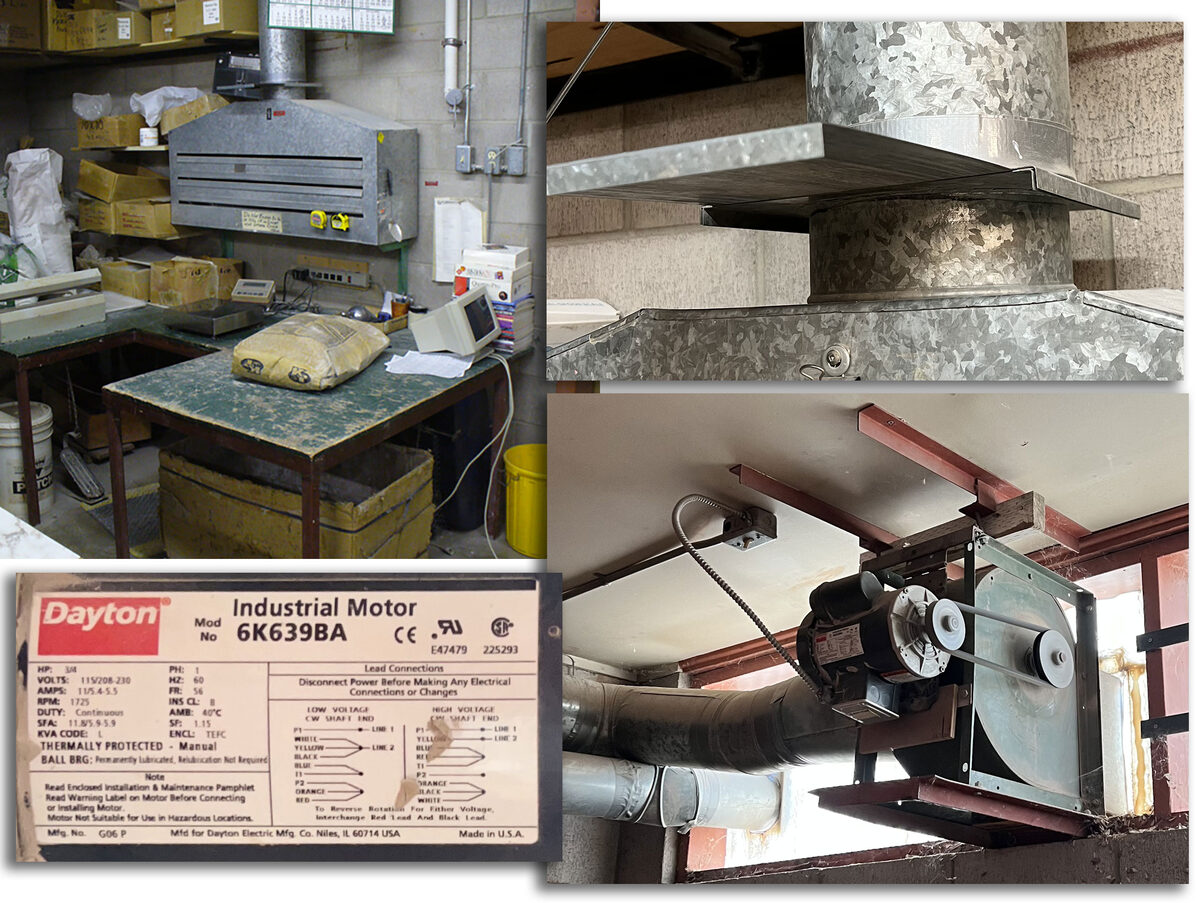
An example of a custom-made dust collection hood in our repackaging and lab recipe mixing area. The slots along the front suck particles into the duct directly away from the operator's face. Suction comes from a centrifugal exhaust fan downstream where the pipe exits the building, it is driven by a 3/4hp motor (these fans are best at sucking, not blowing, so they need to be located at the exit). About 40 feet of 8-inch heating pipe connects from the hood to a fitting that expands to 12 inches going into the fan. The sliding damper above the hood enables stopping all airflow (to prevent heat loss during cold days). Notice it is located above the scale and heat sealer where most dust is generated during weighing and packaging.
N95 Particulate Respirator mask
This picture has its own page with more detail, click here to see it.
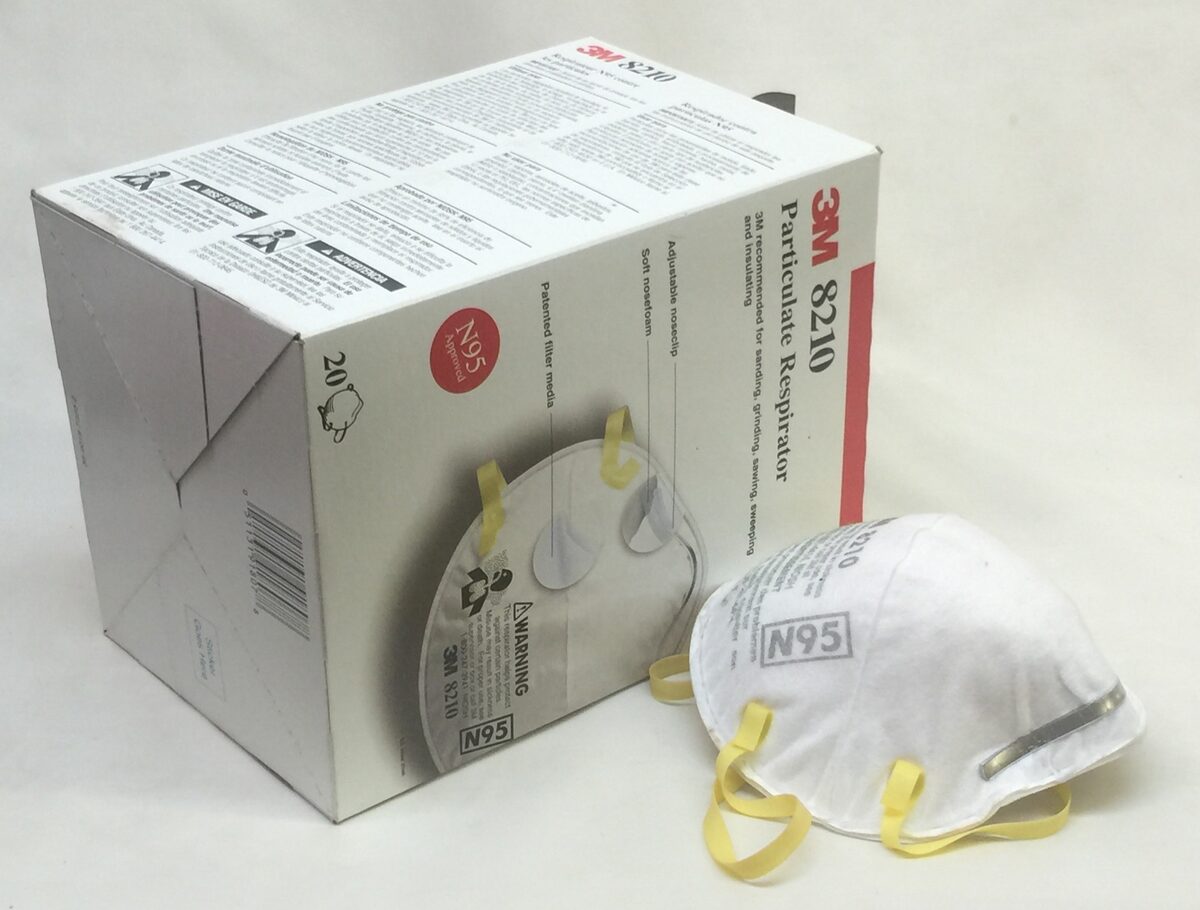
This designation is an international standard for a general purpose respirator to filter out respirable quartz particles (which cause silicosis). Use one of these when working in a area where ventilation is insufficient to remove all of the dust. Use it also in circumstances where there is temporary generation of large quantities of dust. Do not wear this as a substitute for keeping floors and working areas clean.
Sedimentary clays are a whos-who of the periodic table
This picture has its own page with more detail, click here to see it.
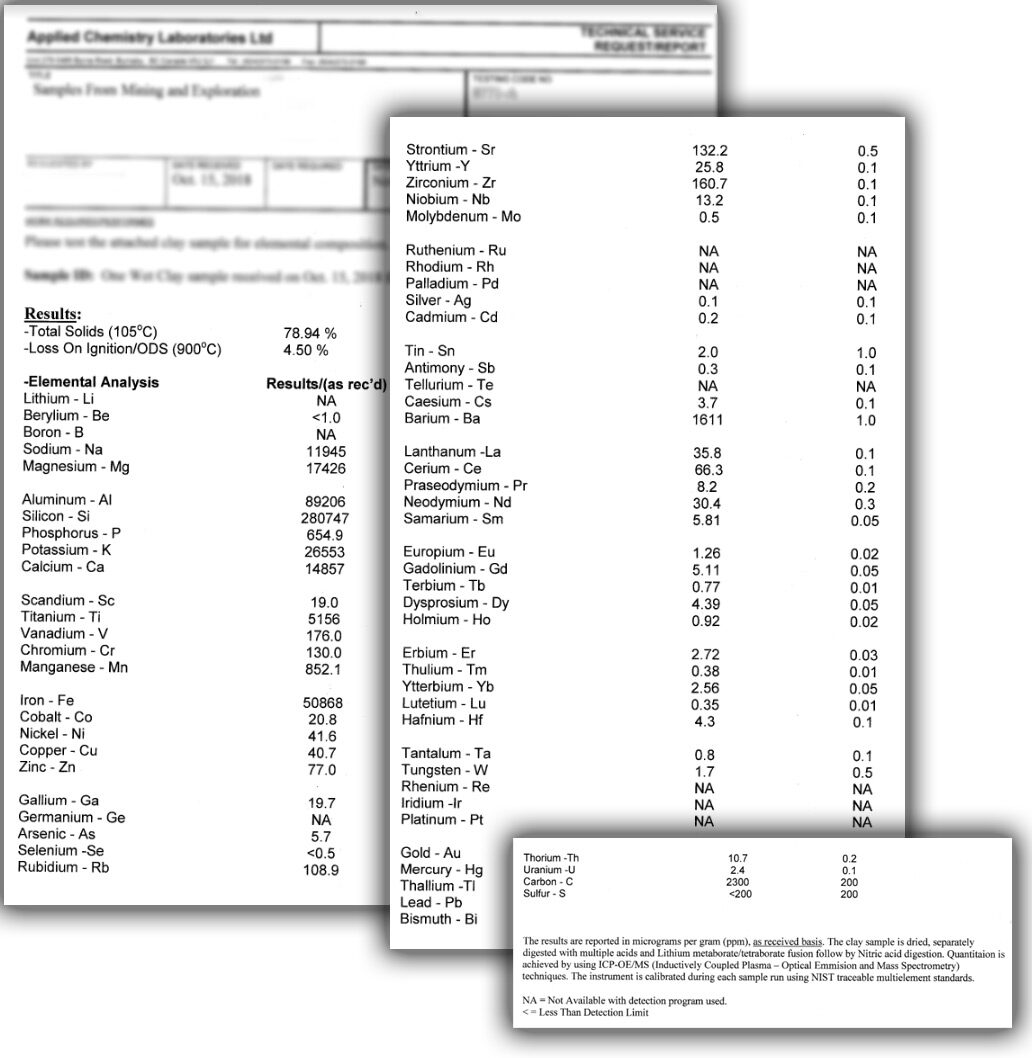
These are the results of a detailed elemental composition analysis of a sedimentary clay. The first column of numbers is ppm (parts per million), divide them by 10,000 to get percent. The Fe here, for example, is 50,868 or 5.1%. The second column is +/- error. Notice that this test does not detect boron or lithium, they require a different method. By contrast, the chemical analysis shown on the data sheet of a typical ceramic material shows only the principle ceramic oxides (less than a dozen), but all of these trace elements will still be present.
Frits instead of raw zinc, lithium, barium, strontium
This picture has its own page with more detail, click here to see it.
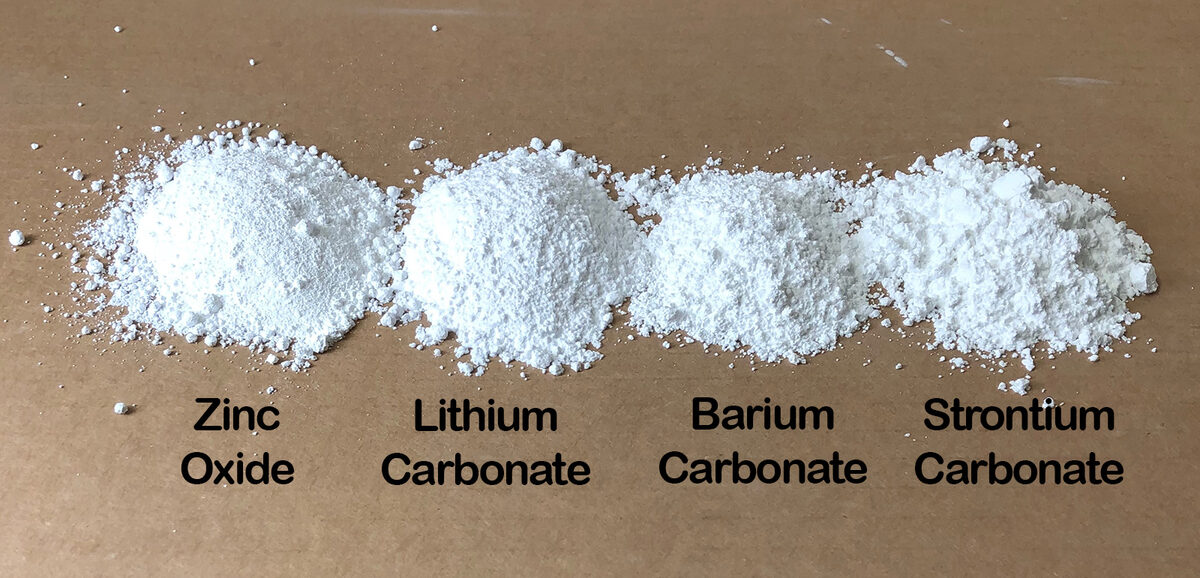
Raw material sources of zinc, lithium, barium, strontium have issues (e.g. precipitates in glaze slurries, toxicity, high drying shrinkage and carbon burnoff that affect laydown and fired surface defects like pinholes, blisters, orange peeling, crystallization). Yet the oxides that these materials supply to the glaze melt - ZnO, Li2O, BaO and SrO, can be sourced from frits which melt much better and remove most of the problems. Consider examples made by Fusion:
-Frit F-493 has 11% Li2O
-F-403 has 35% BaO
-F-581 has 39% SrO
-FZ-16 has 15% ZnO
These frits source other oxides but such are common in most glazes and glaze calculation can be used to retain the overall chemistry. Although these are expensive, the benefits are game changers. But there is a problem: Potters can't get these. Therefore they have difficulty creating the dazzling visual effects of many commercial glazes.
Stains are better in black DIY glazes
Use 5% stain instead of 15% metal oxides
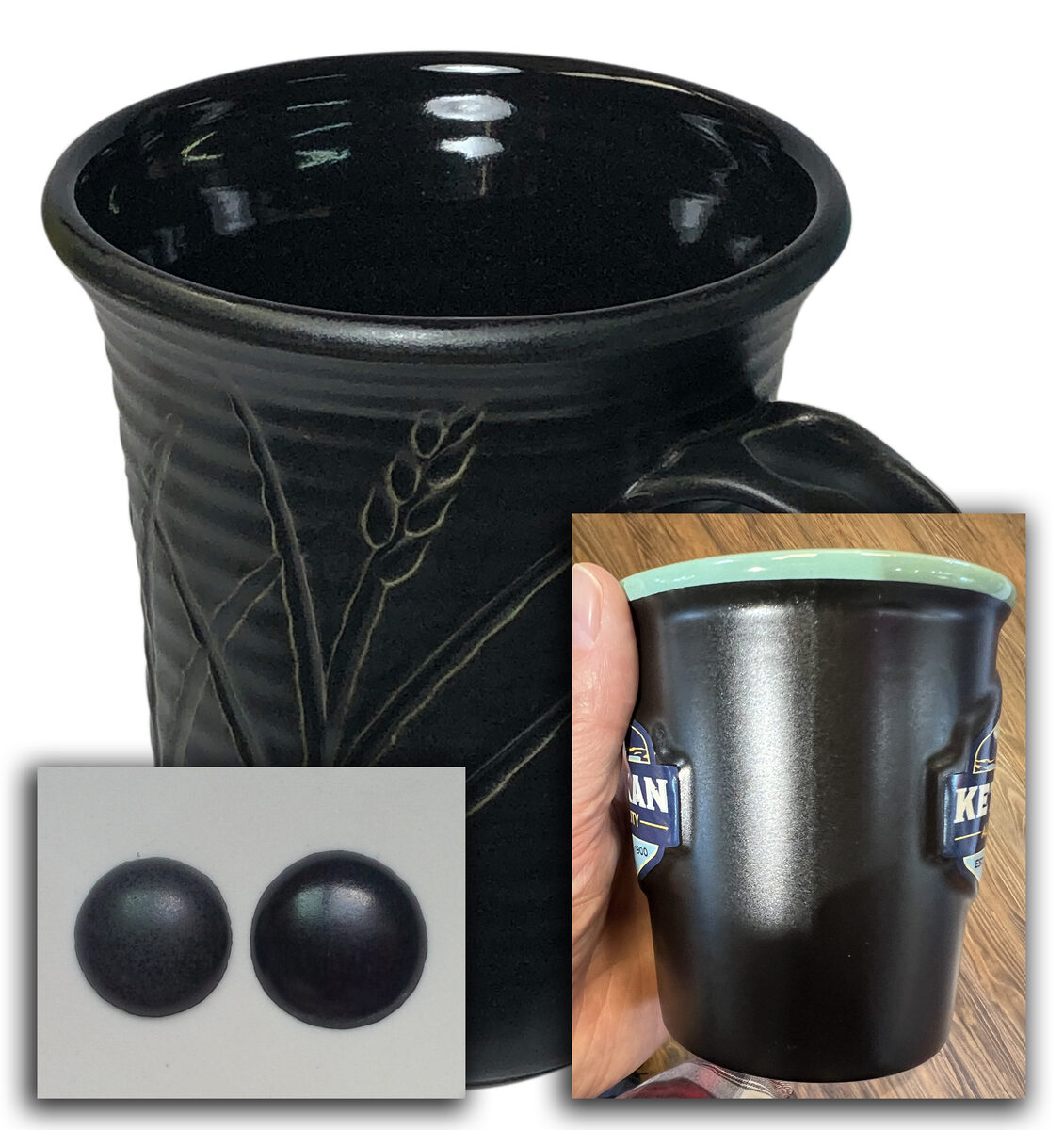
This picture has its own page with more detail, click here to see it.
Consider the hazards and hassles before choosing a black matte or gloss recipe that has high individual or combined percentages of manganese dioxide, cobalt or nickel.
Gloss blacks: These are super popular as the base for layering of reactive glazes. DIY dipping versions thus make a lot of sense. They make even more sense when they don’t turn to jelly in the bucket because of the high percentage of red iron oxide in all blacks made using metal oxide colorants. And when the total percentage of pigment is as high, or higher than 15%. And when the pigments cause crystallization (especially when overloaded).
Matte blacks: The human eye can detect even slight differences in the degree of matteness (which is very difficult to keep consistent). Raw metal oxides affect the matteness, especially when overloaded with pigment. They are prone to cutlery marking if too matte. By using stains, manufacturers and even potters have learned to tune recipes (lower left) and firing schedules to achieve consistency and functionality (even tourist souvenirs (lower right) feature them now). With stains, only one material is producing the color, its percentage (which can be as low as 4%) can be tuned.
Links
| Articles |
Are Your Glazes Food Safe or are They Leachable?
Many potters do not think about leaching, but times are changing. What is the chemistry of stability? There are simple ways to check for leaching, and fix crazing. |
| Articles |
Is Your Fired Ware Safe?
Glazed ware can be a safety hazard to end users because it may leach metals into food and drink, it could harbor bacteria and it could flake of in knife-edged pieces. |
| Articles |
Attack on Glass: Corrosion Attack Mechanisms
Max Richens outlines the various mechanisms by which acids and bases can dissolve glass and glazes. He provides some information on stabilizing glazes against attack. |
| Articles |
Crazing and Bacteria: Is There a Hazard?
A post to a discussion on the clayart group by Gavin Stairs regarding the food safety of crazed ware. |
| Hazards |
Overview of Material Safety by Gavin Stairs
Toxicology and ceramic materials is a complex subject, what materials and methods pose the greatest dangers, which are the safest? |
| Hazards |
Manganese in Clay Bodies
Manganese is used to stain clays (using black) and to impart fired speckling (as a decorative effect). It is dangerous? |
| Glossary |
Leaching
Ceramic glazes can leach heavy metals into food and drink. This subject is not complex, there are many things anyone can do to deal with this issue |