Barnard Slip
Alternate Names: Blackbird Slip, Blackbird Clay, Barnard Clay
Description: High Iron Clay
| Oxide | Analysis | Formula | Tolerance |
|---|---|---|---|
| CaO | 0.30% | 0.05 | |
| K2O | 2.00% | 0.22 | |
| MgO | 0.80% | 0.20 | |
| MnO | 3.50% | 0.50 | |
| TiO2 | 0.70% | 0.09 | |
| Al2O3 | 10.00% | 1.00 | |
| SiO2 | 59.00% | 10.01 | |
| Fe2O3 | 15.00% | 0.96 | |
| LOI | 8.31% | n/a | |
| Oxide Weight | 931.26 | ||
| Formula Weight | 1,015.66 | ||
Notes
Related Information
What really is Barnard Slip?
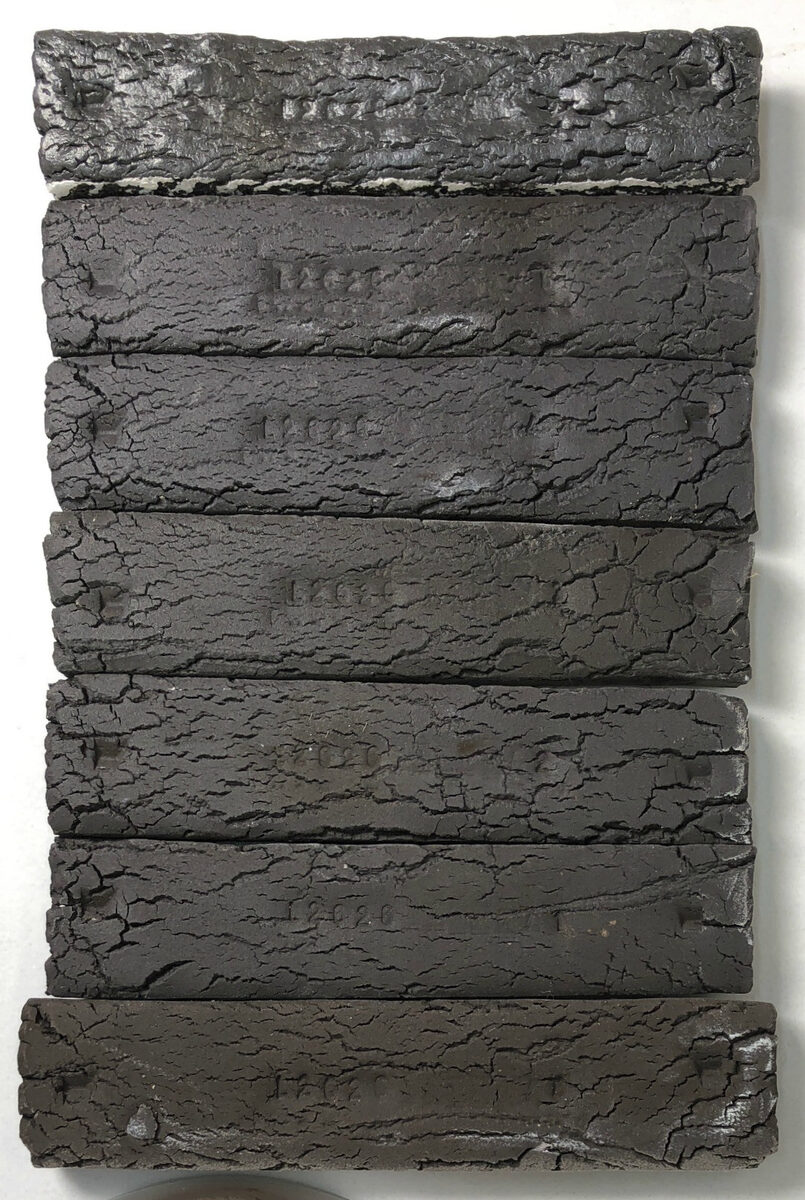
This picture has its own page with more detail, click here to see it.
It is a clay, a very non-plastic one. These are fired SHAB test bars of Barnard Slip going from cone 04 (bottom) to cone 6 (top, where it is melting). Porosity is under 3% and the fired shrinkage above 15% from cone 1 upward (second from bottom). Drying shrinkage is 4% at 25% water (it is very non-plastic). The darkness of the fired color suggests higher MnO than our published chemistry shows (and also higher iron). The white areas on the lower temperature bars are soluble salts.
Since this is a fine particled material, it could likely be made plastic with a bentonite addition, likely 5% or more would be needed. Solubles could be precipitated using barium carbonate.
Links
| Materials |
Albany Slip
A pure low plasticity clay that, by itself, melted to a glossy dark brown glaze at cone 10R. It was a popular glaze ingredient for many decades. |
| Materials |
Ravenscrag Slip
A light-colored silty clay that melts to a clear glaze at cone 10R, with a frit addition it creates a good base for a wide range of cone 6 glazes. |
| Materials |
SG 758
|
| Typecodes |
Clay Other
Clays that are not kaolins, ball clays or bentonites. For example, stoneware clays are mixtures of all of the above plus quartz, feldspar, mica and other minerals. There are also many clays that have high plasticity like bentonite but are much different mineralogically. |