Electric Hobby Kilns: What You Need to Know
Description
Electric hobby kilns are certainly not up to the quality and capability of small industrial electric kilns, being aware of the limitations and keeping them in good repair is very important.
Article
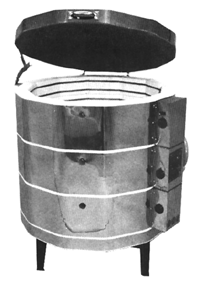
Firing an electric kiln is like using a microwave oven, right? Just slap the ware in, slam the lid, set the controller to cone fire, and take out the beautiful ware the next day. It is that simple isn't it? Not quite! If you are using a top-loading hobby electric kiln for stoneware pottery, it is good to be aware of some things. Compared to industrial electric kilns, these kilns are fragile, hard to control, difficult to maintain, fire unevenly, have little or no ventilation and are an energy hog! They have no element holders, no draft, a heat-leaking lid, bulky energy-stealing kiln furniture and a toy controller. Yet hobby kilns have proven great for earthenware and slip-cast ceramics that do not require tight control and they have also given many people the opportunity to get into stoneware pottery and porcelain, and even small-scale manufacturing. Producing somewhat consistent ware will be a matter of learning to program the up and down temperature ramps to compensate the amount of ware in the chamber with the inaccuracy of the pyrometer and the condition of the elements. Uptime will depend on being vigilant about maintenance (e.g. replacing relays, thermocouples, elements as needed). Before getting too depressed, it is possible to do amazing things: Crystalline glazes for example were once the domain of a select few, but now they are simple because of these devices.
Consider some specific points about making these contraptions work:
- Modern electric hobby kilns have electronic controllers. This sounds impressive at first, but in some ways, it is an efficient method to automate failure. It is still necessary to think about what is the best firing schedule for your type of ware and implement it in a way the kiln hardware is capable of reproducing (for both up and down ramps). Close monitoring is needed to be sure of ongoing accurate reproduction, because, in ceramics, lack of consistency in firing will certainly bring issues. The kiln depends on the thermocouple to know what the temperature is and the elements to heat it up. As already noted, components are consumer-grade, they have their limits and need maintenance and replacement regularly. Mechanical sitter devices introduce even more things that need maintenance and adjustment (the rod and supports bend a little with each firing).
- Use cones. Consistently accurate firings will not happen with traditional cones. Cones indicate what firing actually happened, which is valuable information to compensate the firing program. Their presence in firing after firing will indicate when the thermocouple is starting to stray or alert you to other issues. Self-supporting cones are by far the best.
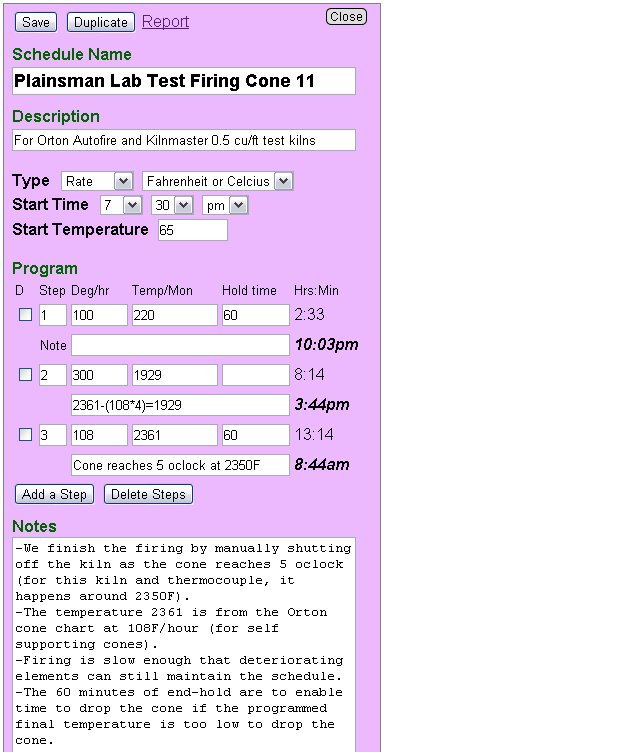
- Document firing schedules and stick to them. Adjust and perfect them over time. The schedule manager in Insight-live.com enables accurately predicting when firings will end (provided no part of the schedule climbs faster than what the elements can deliver). At Plainsman Clays, we have found that we can predict the end of firings from cone 06 to 11 to within 5 minutes! For the most accurate firing, this is valuable because it enables overriding when necessary (to finish early or continue if the cone has not fallen to the proper angle).
- Electric kilns fire very unevenly as a result of compartmentalization created by full kiln shelves that reach to nearly the edge of the chamber, elements of differing efficiency, uneven distribution of ware and kiln furniture, improperly sealed lid, poor insulation, lack of draft and the high ratio of shelf-weight to ware-weight. A controller that compensates zones can improve matters. Setting cones to be visible in peepholes on all levels of the kiln also enables stacking future firings with this in mind. Use as little kiln furniture as possible, distribute it evenly throughout the chamber, and use half shelves where practical (to prevent the compartmentalization). But even with all this, heavy ware cannot be fired evenly no matter how long the kiln is held at temperature. That is because electric kilns heat via radiation and the shady side away from the elements is always going to be cooler than the element side.
- As noted, hobby kilns are poorly insulated. A typical potter thinks that 2200F is really hot because his/her kiln has to struggle so much to get that high. But kilns can go much higher (e.g. 2800F). Industrial kilns are light-years ahead of hobby kilns. Better refractories. Better bricks, thicker walls, ceramic fiber, better elements, more elements, etc. All of this being said, since hobby kilns do not have forced ventilation it would not be possible to fast-cool them evenly if they were better insulated, so they are what they are!
- In industry, the final pore water is removed quickly and evenly from ware in drying chambers that employ boiling-point temperatures and very stiff humidity-controlled drafts. Pottery kilns simply use the early stages of firing to dry ware. As mentioned, an electric kiln has little or no draft to remove pore (and crystal water) so a humid atmosphere persists, even where ware starts to get really hot. A dedicated drier is the norm in industry but not usually an option for potters, so the only alternative is to heat slowly at the low end (we hold the temperature at 250F for hours if needed).
- Fire slower and soak at the end. Firings will be more even, consistent, ware will be better quality, glazes will have less imperfections. This is especially true when firing a heavy mass of ware. Firing too quickly and not soaking at the end of the firing means the ware simply will not reach temperature (even though cones or instruments may indicate otherwise). Since the color of stoneware clays typically varies with temperature, comparing the color of unglazed surfaces on light thin pieces with heavy thick ones will indicate differences in maturity.
- Smaller electric hobby kilns shine at lower temperatures (e.g. cone 04-2). Elements can endure a thousand firings on adequately powered kilns. Conversely, the elements and relays in larger electric kilns that are usually fired full might only last 100 firings.
- Make sure the lid of your kiln is sealing well all the way around. When changing elements, do them all at once when possible. Also, make sure switches (on older style kilns) are well-ventilated or they will overheat and fail (kilns lacking venting on the switch housings are prime candidates for burning out switches).
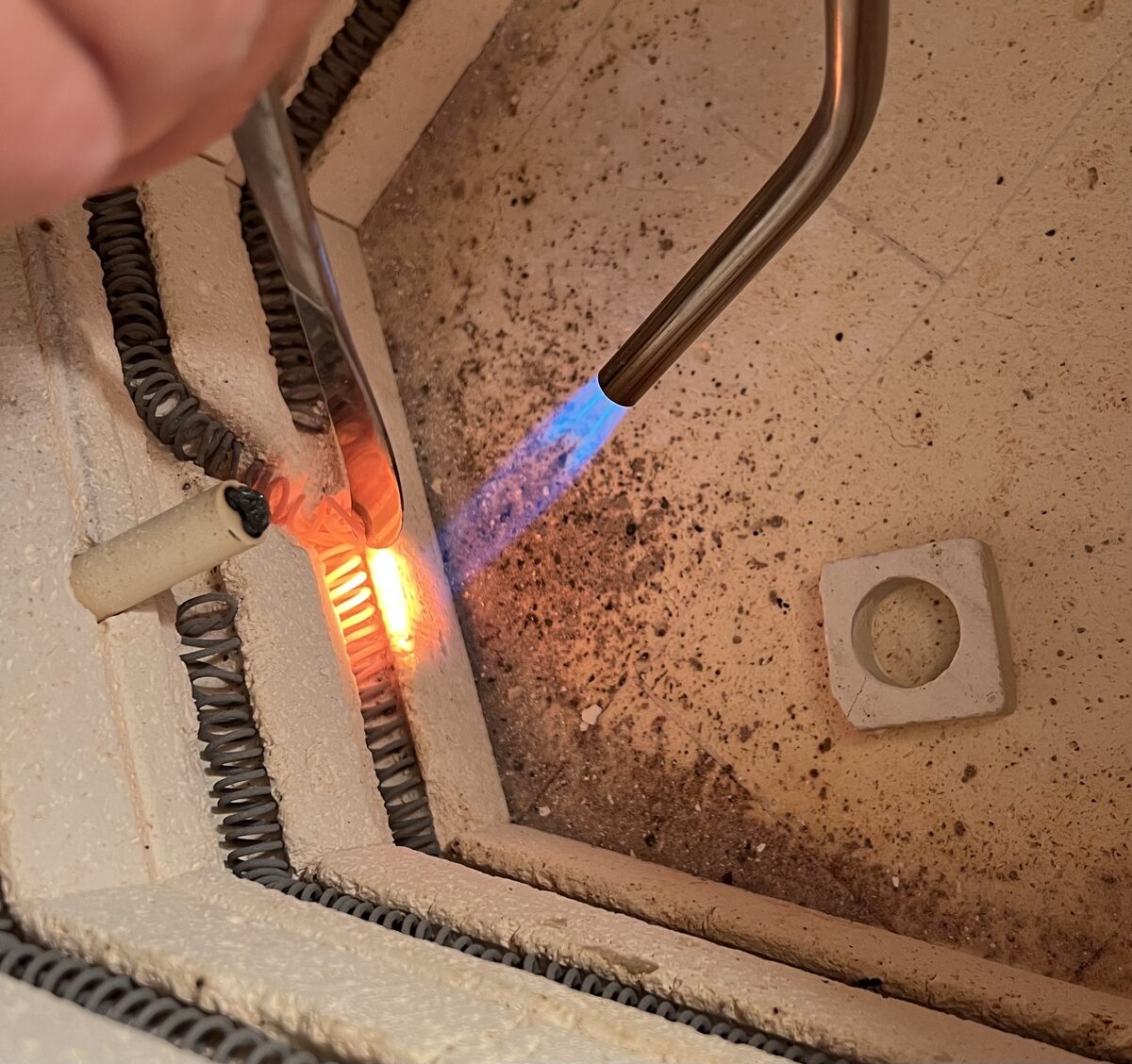
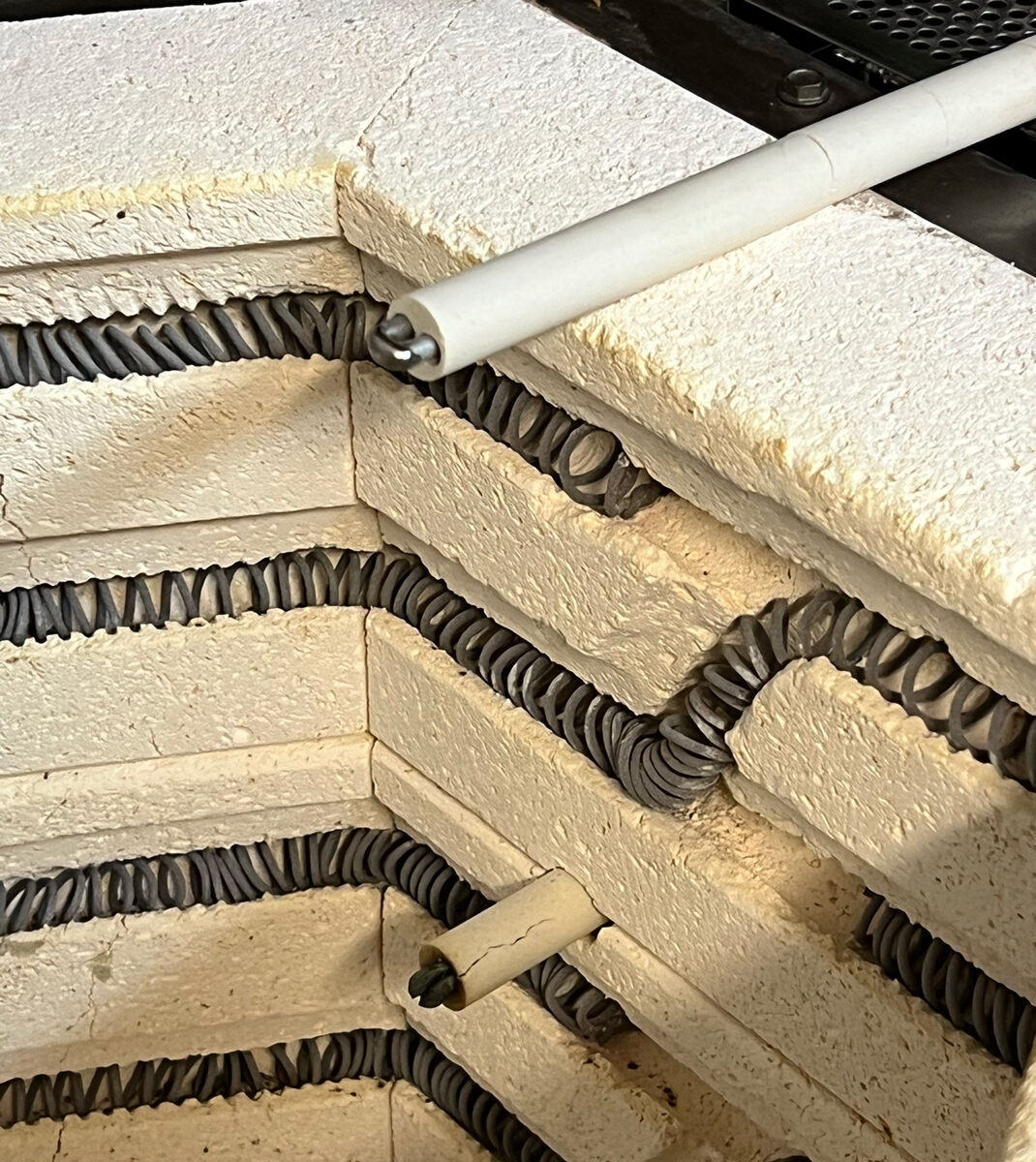
- Electric kilns are fragile, so treat them with care. When changing elements, use a plumbers torch to soften elements to they pull out of groove corners without damaging bricks. When installing: Read the instructions carefully, use good crimp or screw connectors, and quality tools. Make sure the elements are not stretched into the groves, under no tension and be bent to stay in the corners.
- Ventilation Systems: These introduce draft, a key to improved fired results (if the interior of the kiln can be kept at even temperatures throughout). When products of decomposition are removed quickly during firing (especially carbon, sulfur) results are much better and problems are fewer.
Hobby kilns are not so bad after all. Like so many other things in ceramics, limitations can be compensated for by experience, care and an electronic controller.
Should you get a gas kiln instead? Be prepared for quadruple the price! And installation hassles and costs that could double that again! At cone 10 high temperatures are "on your side", all the common ceramic materials melt easily so frits are not needed. Bodies and glazes are less expensive. Glazes seem to just fit bodies naturally. Ware durability is almost a given. That being said, gas kilns require more expertise and dedication to fire and willingness to lose loads of ware during the learning period. Since there is a danger of spending $50,000 and running into serious issues it is best to buy one through your local ceramic supplier to get their support. A big advantage of this is being sure about by-laws and installation issues.
Related Information
Firing schedules at insight-live.com
This picture has its own page with more detail, click here to see it.
A cone 11 oxidation firing schedule (I maintain in an account at insight-live.com). Using these schedules, I can predict the end of a firing within 5-10 minutes at all temperatures. I can also link schedules to recipes and report a schedule so it can be taken to the kiln and used as a guide to enter the program.
The difficulty of vitrifying ware in electric kilns
This picture has its own page with more detail, click here to see it.
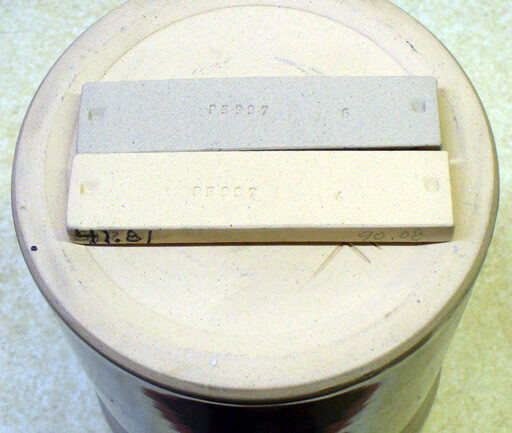
This 1 gallon heavy crock was fired to cone 6 (at 108F/hr during the final 200 degrees) and held 20 minutes (in a electric kiln). The bare clay base should be the color of the top test bar (which has gone to cone 6). Yet, it is the color of the bottom bar (which has gone to cone 4)! That means the base only made it to cone 4. The vertical walls, which we exposed to the direct radiant head of the elements, are the right color (so they made cone 6). It may seem that this problem could be solved by simply firing with a longer hold at cone 6. But again, electric kilns heat by radiation, that shielded and heatsunk base will never get the same thermal treatment as the sidewalls!
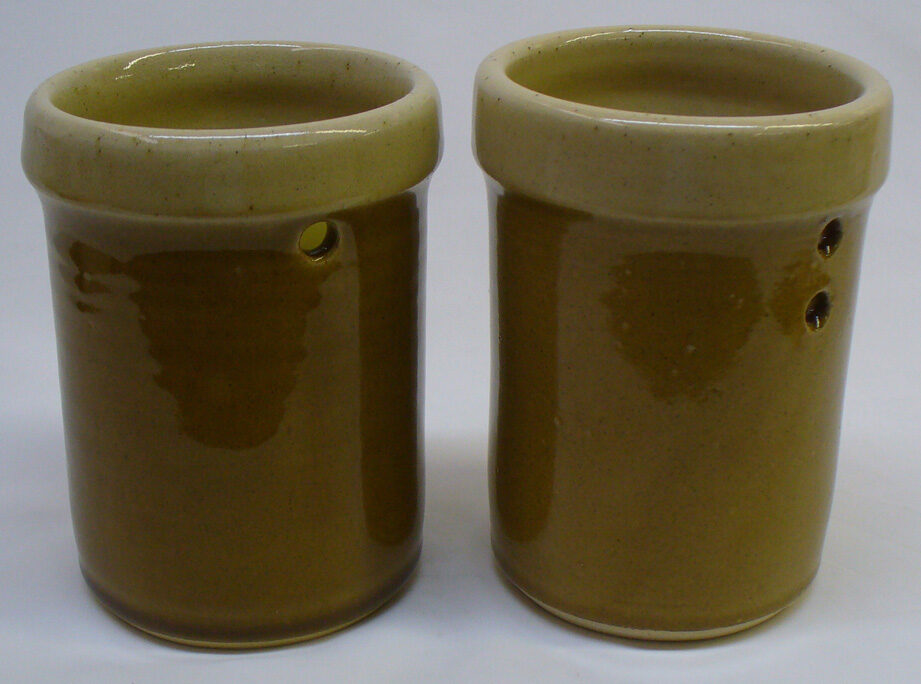
Same cone 6 glazes. Same clay. Why is the one on the right pinholing?
This picture has its own page with more detail, click here to see it.
These are thick pieces, they need time for heat to penetrate. Both were soaked 15 minutes at cone 6 (2195F in our test kiln). But the one on the left was control-cooled to 2095F degrees and soaked 45 more minutes. Pinholes and dimples are gone, the clay is more mature and the glaze is glossier and melted better. Why is this better than just soaking longer at cone 6? As the temperature rises the mineral particles decompose and generate gases (e.g. CO2, SO4). These need to bubble through the glaze. But on the way down this activity is ceasing. Whatever is gassing and creating the pinholes will has stopped by 2095F. Also, these are boron-fluxed glazes, they stay fluid all the way down to 1900F (so you could drop even further before soaking).
These two pieces will not mature to the same degree in a firing
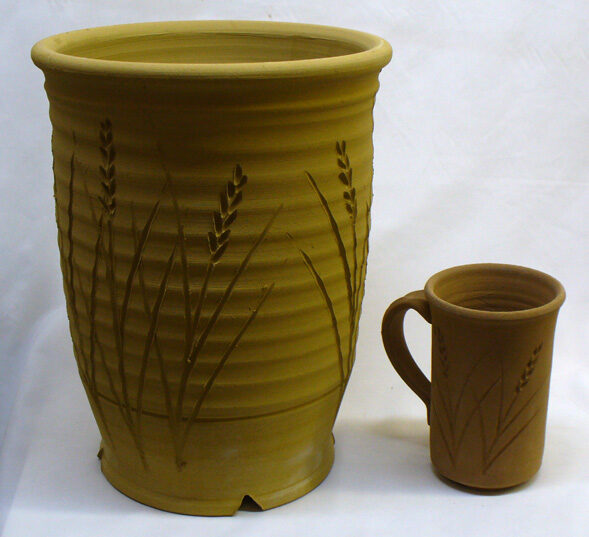
This picture has its own page with more detail, click here to see it.
Soak the firing 30 minutes and the mug would mature throughout. But not the planter. Soak 2 hours for the planter and the mug may over-mature and bloat or warp. This is a troublesome issue with electric kilns. Furthermore, they employ radiant heat. That means that sections of ware on the shady side (and the under sides) will never reach the temperature of those on the element side - no matter how long the firing is held at temperature.
Resurrecting and old kiln by replacing elements
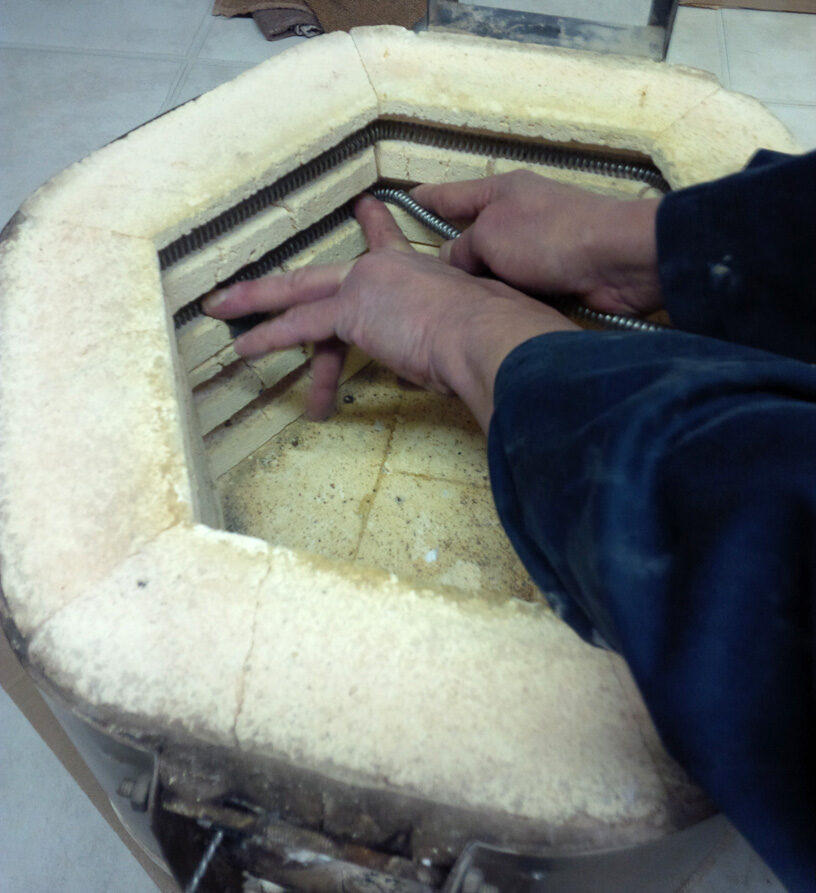
This picture has its own page with more detail, click here to see it.
Replacing the elements in a old test kiln turns it into a new kiln! Relays are also checked. Notice how the elements are bent and pushed well into the corners. If this is not done properly, they will pull out of the corners after it is fired a few times.
How to get more accurate firings time after time
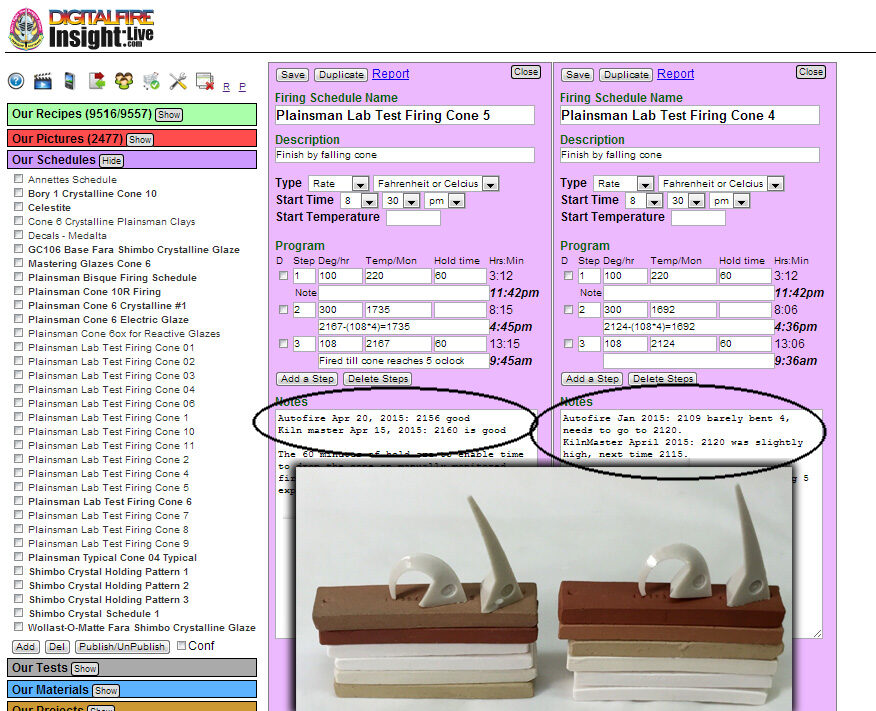
This picture has its own page with more detail, click here to see it.
When I fire our two small lab test kilns, I always include cones (I fire a dozen temperatures). I want the firing to finish when the cone is around 5- 6 o'clock. To make that happen, I record observations on which to base the temperature I will program for the final step the next time. Where do I record these? In the schedules I maintain in an Insight-live.com account. I use this every day, it is very important because I need accurate firings.
Manually programming a Bartlett V6-CF hobby kiln controller
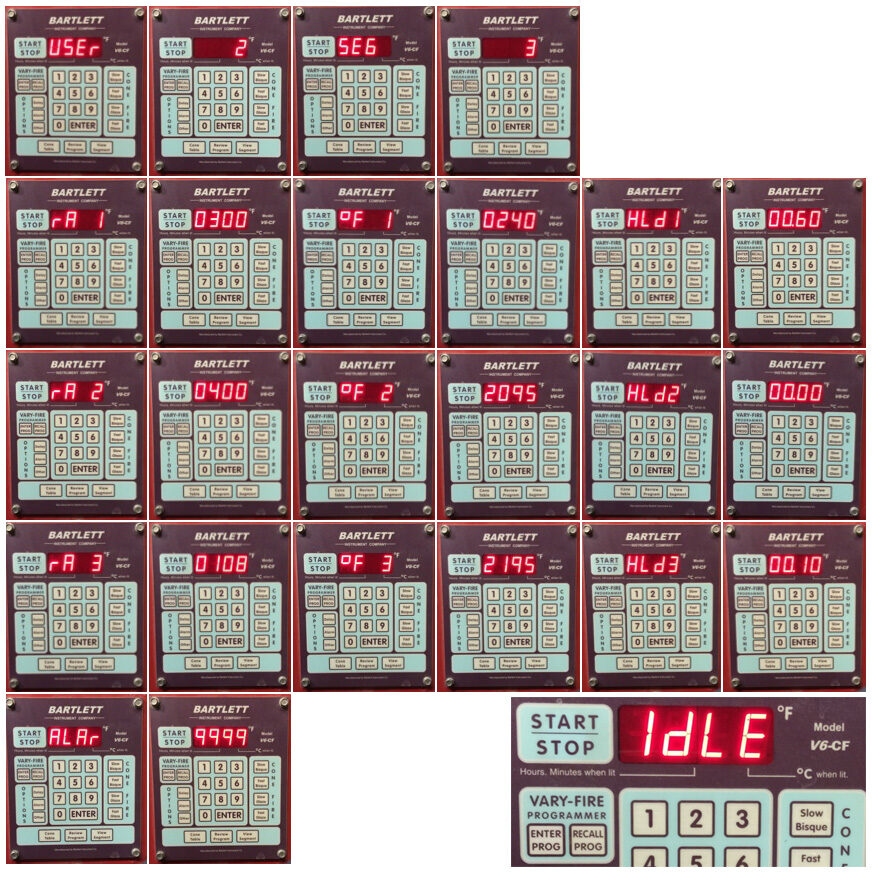
This picture has its own page with more detail, click here to see it.
I document programs in my account at insight-live.com, then print them out and enter them into the controller. This controller can hold six, it calls them Users. The one I last edited is the one that runs when I press "Start". When I press the "Enter Program" button it asks which User: I key in "2" (for my cone 6 lab tests). It asks how many segments: I press Enter to accept the 3 (remember, I am editing the program). After that it asks questions about each step (rows 2, 3, 4): the Ramp "rA" (degrees F/hr), the Temperature to go to (°F) to and the Hold time in minutes (HLdx). In this program I am heating at 300F/hr to 240F and holding 60 minutes, then 400/hr to 2095 and holding zero minutes, then at 108/hr to 2195 and holding 10 minutes. The last step is to set a temperature where an alarm should start sounding (I set 9999 so it will never sound). When complete it reads "Idle". Then I press the "Start" button to begin. If I want to change it I press the "Stop" button. Those ten other buttons? Don't use them, automatic firing is not accurate. One more thing: If it is not responding to "Enter Program" press the Stop button first.
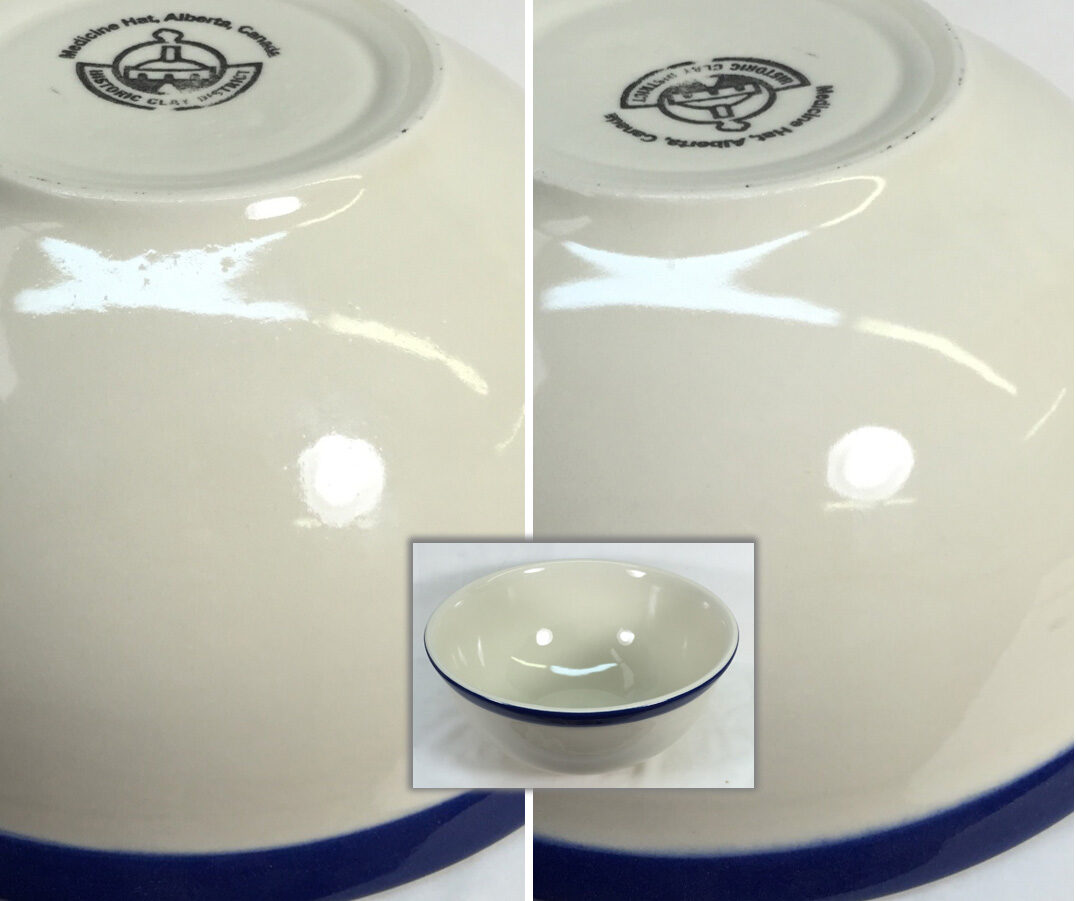
Can this 5 lb thick walled bowl be fired evenly in an electric kiln. No.
This picture has its own page with more detail, click here to see it.
When electric kilns, especially large ones are tightly packed with heavy ware, the shady or undersides of the pots simply will never reach the temperature of the element side, no matter how long you soak. In this example, the inside of this clear glazed cone 6 bowl has a flawless surface. The base is pinholed and crawling a little and the surface of one side (the shady side), the remnants of healing disruptions in the melt (from escaping gases) have not smoothed over. The element side is largely flawless like the inside, however it is not as smooth on the area immediately outside the foot (because this is less element-facing). Industrial gas kilns have draft and subject ware to heat-work by convection, so all sides are much more evenly matured.
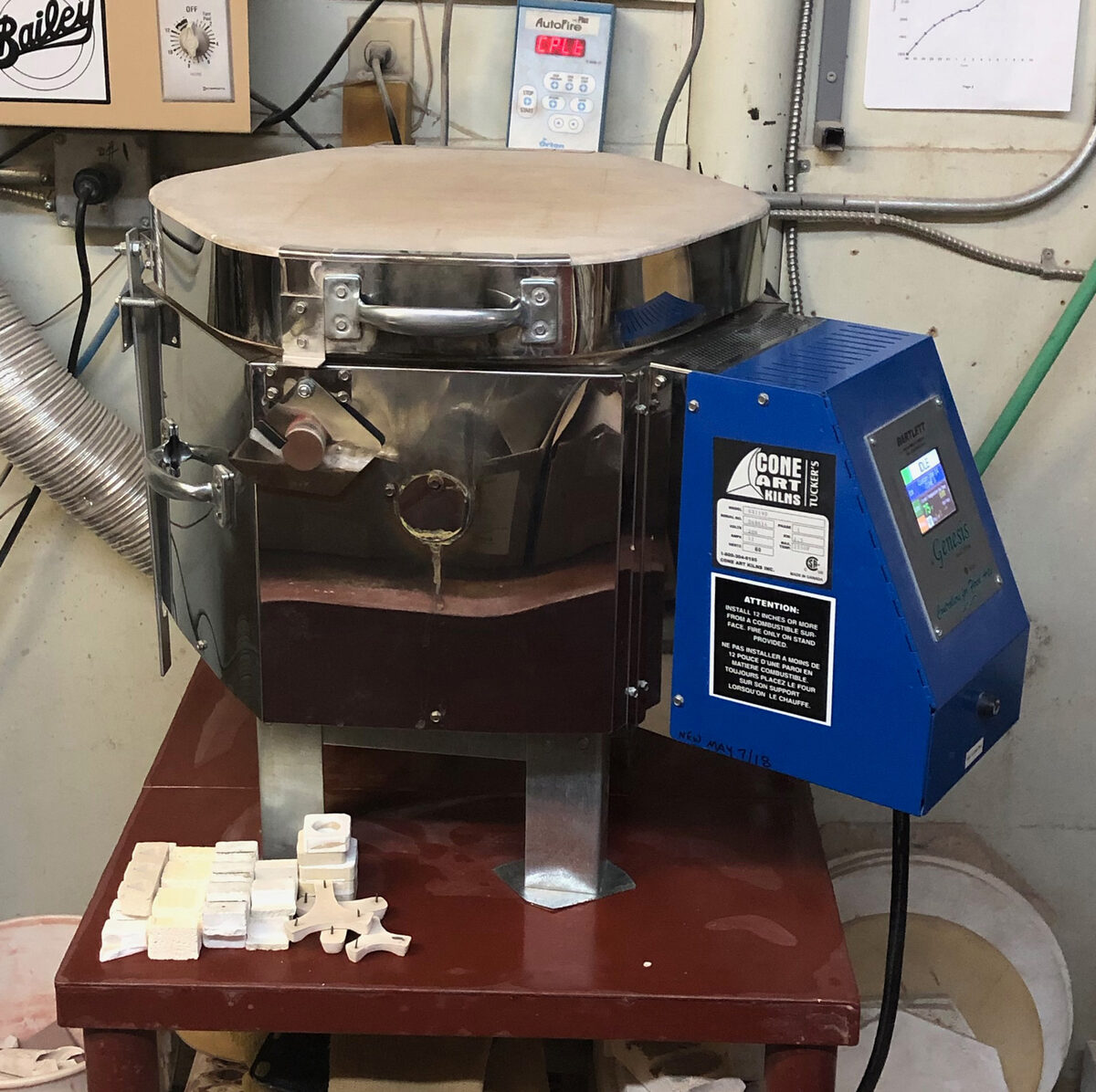
A test kiln with firing controller: A necessity.
This picture has its own page with more detail, click here to see it.
Every potter should have one of these. Every clay body manufacturer should have one. This one has a Bartlett Genesis electronic controller, you will never go back after having one. Start with a kiln like this and then graduate to having a large, second kiln (or more of these if you are doing lab or development work). We have done 950 firings on this one in the past few of years, it is still like new. Ongoing testing is the key to the constant development of your products and their quality.
Pushing kiln elements back into the groove
This picture has its own page with more detail, click here to see it.
Over time kiln elements can sag out of the channel. With each firing the problem gets worse. The elements are far too brittle to simply bend and push back in. As long as they are still in good condition this is the way to do it: Heat them with a plumbers torch and they will be pliable enough to move without breaking.
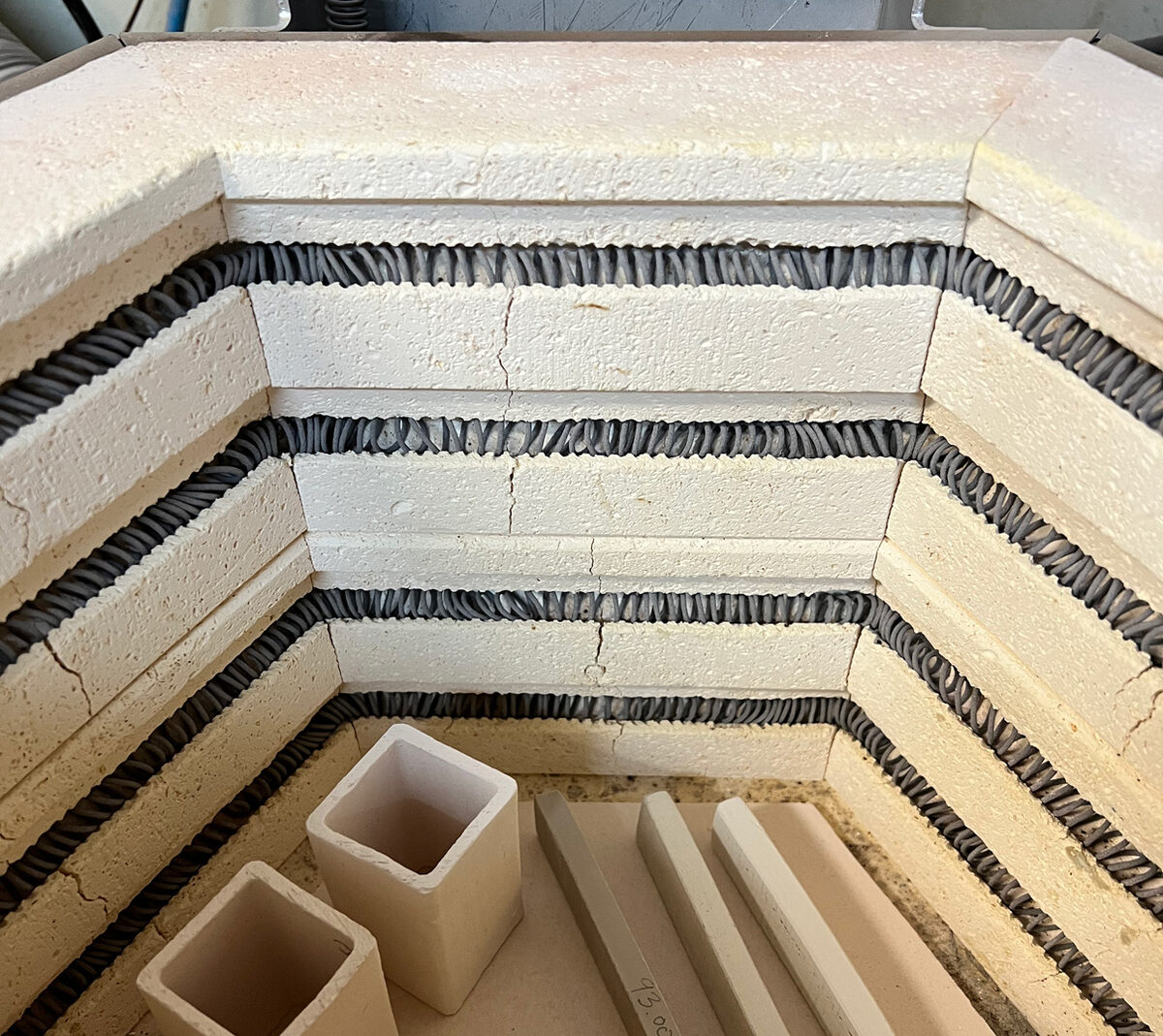
Do these kiln elements need replacing?
This picture has its own page with more detail, click here to see it.
This 12 inch test kiln has done 910 firings. The element loops are laying down and nearly touching each other. If they are not changed soon the coils will touch the kiln will have hot spots. And the coils are expanding and getting tighter in the grooves, the longer we wait the more the grooves will be damaged when removing them. Although elements seem expensive, when costed on a per/firing basis they can be surprisingly inexpensive. Most hobby kilns service two elements with each relay and relays generally need to be replaced more often than elements. Consider, for example, replacing the elements on a Skutt 818. Being a smaller kiln it is well-powered in relation to size and elements can last up to 1000 firings (assuming 50:50 bisque and cone 6 firings). It has 4 elements and 2 relays (relays cost $65/ea, elements $95 each). The labor to replace is ~4 hours or $250 - total cost is about $750 (that is ~75¢ per firing or 32¢ per ft³). How about a larger kiln? An 8 ft³ Model 1222 has 5 elements and 3 relays and replacement is ~$1100. But its elements are only likely to last 200 firings. That yields a per firing cost of ~$5 and per ft³ of 65¢. But there is a much greater cost to consider: Old elements increase power consumption. An 818 uses 6.4 kwH and a 1222 uses 11.5 kwH - at our electricity cost of 14¢/kwH a firing costs ~$7 for the small kiln and ~$13 for the large one. But that is the cost when elements are new. When they need changing those numbers can more than double! An additional cost of old elements is ware consistency, the kiln cannot execute the firing schedule in the time programmed and this will likely affect the appearance of bodies and glazes.
This electric kiln thermocouple needs replacement
This picture has its own page with more detail, click here to see it.
The old one inside is in bad condition (a new one is sitting on top ready to install). In 2022 these cost about $35 CDN. The temperature-measuring part of a thermocouple is the join of two dissimilar metal wires, these are 8 gauge. The junction produces a temperature-dependent voltage that a pyrometer or controller can convert to a reading. Thermocouples can degrade into pretty poor condition yet still work, notice the one in this kiln is separating in two. Thermocouples generally need replacement more often than elements, they generally last about 150 firings (cone 04-06) and 50 firings (cone 6). Replacing these does not require electrical expertise.
22 inch slabs successfully fired after a change. What?

This picture has its own page with more detail, click here to see it.
Giant thin meter-square tiles are fired flat and crack-free by tile companies. How? Kilns that heat evenly from above and below (the tiles are on rollers). But these round tiles are being fired in an electric kiln, a device incapable of heating a large slab evenly. They are so large they reach almost to the outer walls. That means the outer edges receive direct radiant heat from the elements, this sets up a temperature gradient running from the edges toward the center. Passing such a piece up and down through quartz inversion thus creates a wave of sudden expansion and contraction moving through the piece. The artist was losing every one of these to dunting. It is not really advisable to even try this - but he was determined to do it anyway. One change in the process brought this one through: Slowing down to 50F/hr up and down through the quartz inversion (950-1150F).
Links
| Glossary |
Soaking
The process of holding a kiln at the final temperature (or at other temperatures) to enable the heat to penetrate the ware or to effect or complete a glaze or body reaction |
| Glossary |
Firing Schedule
Designing a good kiln firing schedule for your ware is a very important, and often overlooked factor for obtained successful firings. |
| Glossary |
Pyrometric Cone
Cones are ceramic and bend through a narrow temperature range. They used to be actively used to determine when firings were completed but now are used to calibrate electronic devices. |
| Glossary |
Oxidation Firing
In ceramics, this term is most often used to refer to kilns firing with an atmosphere having available oxygen to react with glaze and body surfaces during firing |
| Glossary |
Kiln Controller
In ceramic kilns the firing schedule is typically managed automatically by an electronic controller. But that may not mean that ware gets automatically fired to the correct temperature and atmosphere. |
| Glossary |
Cone 6
Also called "middle temperature" by potters, cone 6 (~2200F/1200C) refers to the temperature at which most hobby and pottery stonewares and porcelains are fired. |
| Articles |
Firing: What Happens to Ceramic Ware in a Firing Kiln
Understanding more about changes taking place in the ware at each stage of a firing helps tune the curve and atmosphere to produce better ware |
| Articles |
Working with children
Go in with both eyes open if you are planning to work with clay with a group of children! A lot can go wrong but it can be unforgettable for them when it goes right. |